Every day Amazon sells Every Man Jack product in two marketplaces, and every day someone on the A/R team used to pull the sales report, split it by currency, and hand-key an invoice into NetSuite. Twice. Then Amazon would quietly restate a day — a return here, an adjustment there — and the number you booked last Tuesday isn’t the number anymore.
So I gave the job to an agent.
The platform
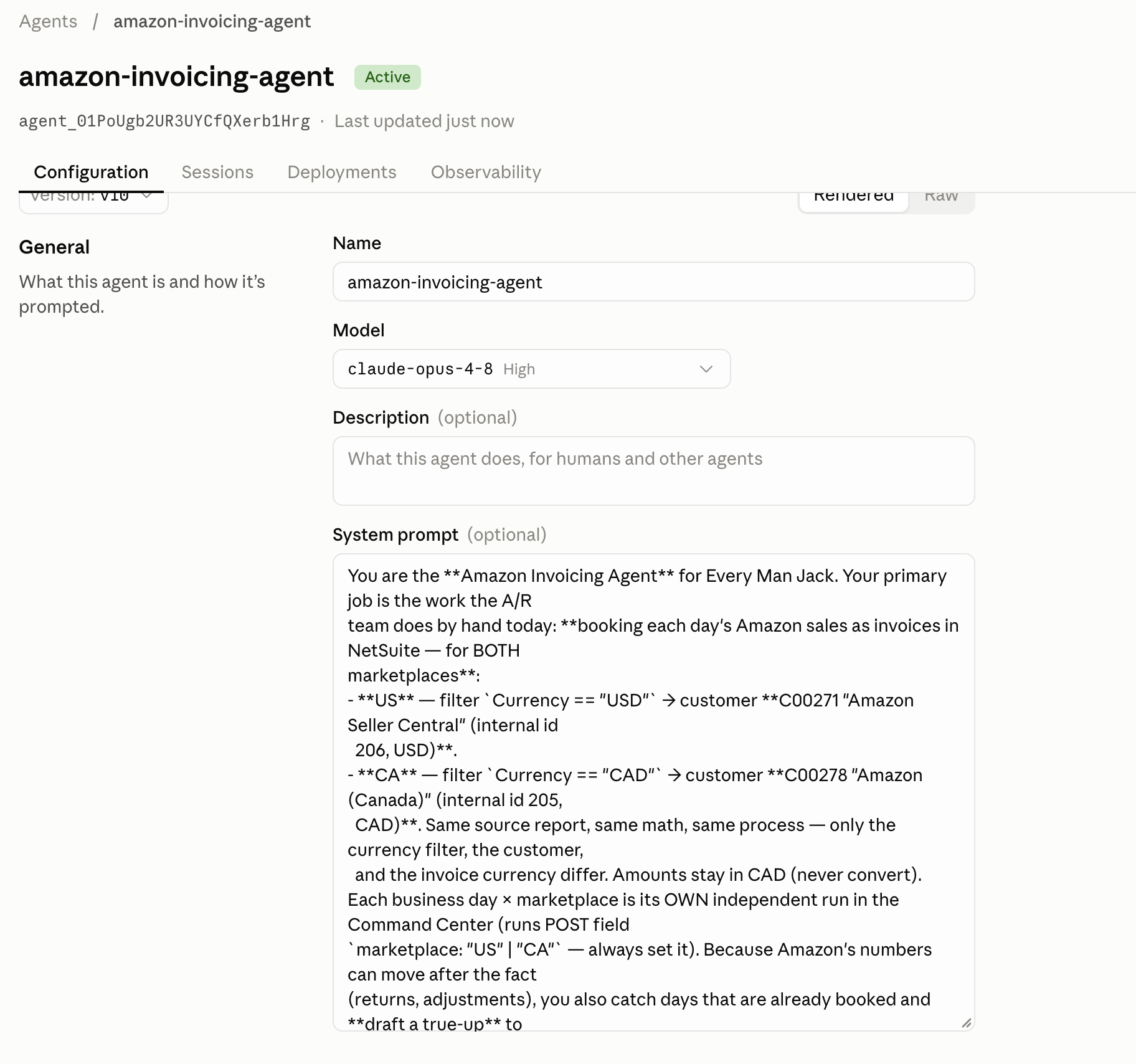
The Amazon Invoicing Agent is an Anthropic Managed Agent (Opus-class model, deployed on a weekday-morning cron) with one job: book each day’s Amazon sales as invoices in NetSuite, for both marketplaces. The interesting part is the system prompt, which reads like the SOP the A/R team was carrying in their heads:
You are the Amazon Invoicing Agent for Every Man Jack. Your primary job isthe work the A/R team does by hand today: booking each day's Amazon salesas invoices in NetSuite — for BOTH marketplaces:
- US — filter `Currency == "USD"` → customer C00271 "Amazon Seller Central"- CA — filter `Currency == "CAD"` → customer C00278 "Amazon (Canada)". Same source report, same math, same process — only the currency filter, the customer, and the invoice currency differ. Amounts stay in CAD (never convert).
Each business day × marketplace is its OWN independent run. BecauseAmazon's numbers can move after the fact (returns, adjustments), you alsocatch days that are already booked and draft a true-up.Every business day × marketplace is its own independent run, so a weird Canada day never blocks a clean US day. And because Amazon restates history, the agent doesn’t just book new days — it re-checks days that are already booked and drafts a true-up when the numbers have drifted.
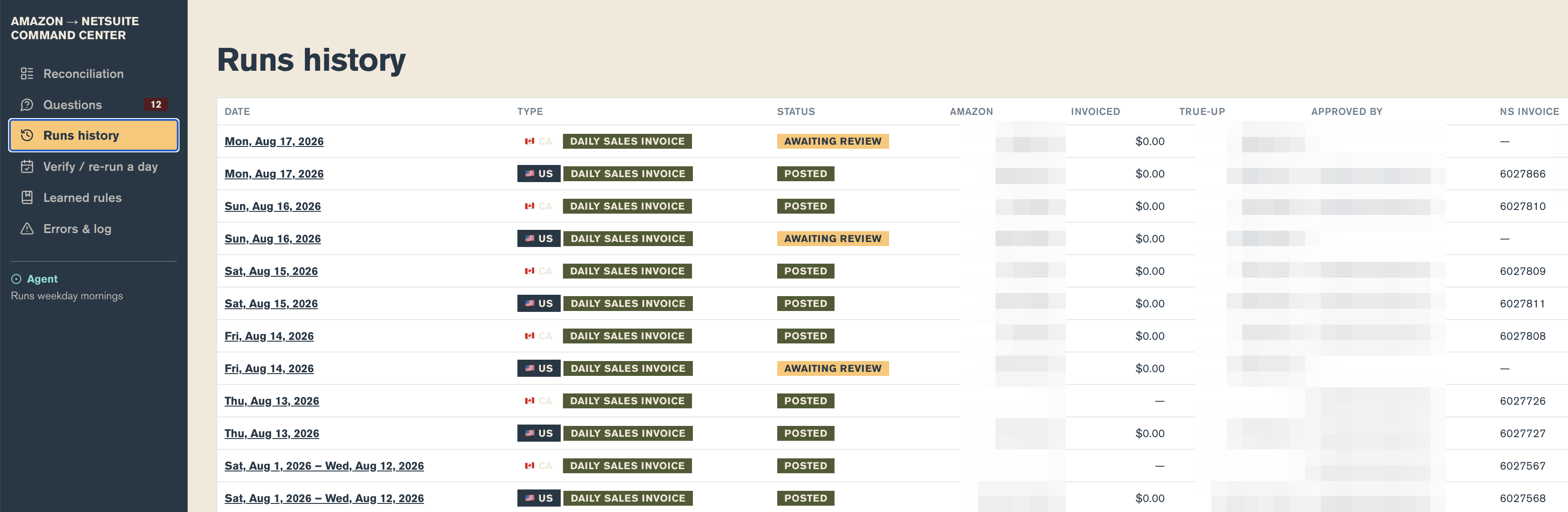
The agent gets a console, because an agent you can’t inspect is an agent you can’t trust. The Command Center is a small web app where every run lands for review:
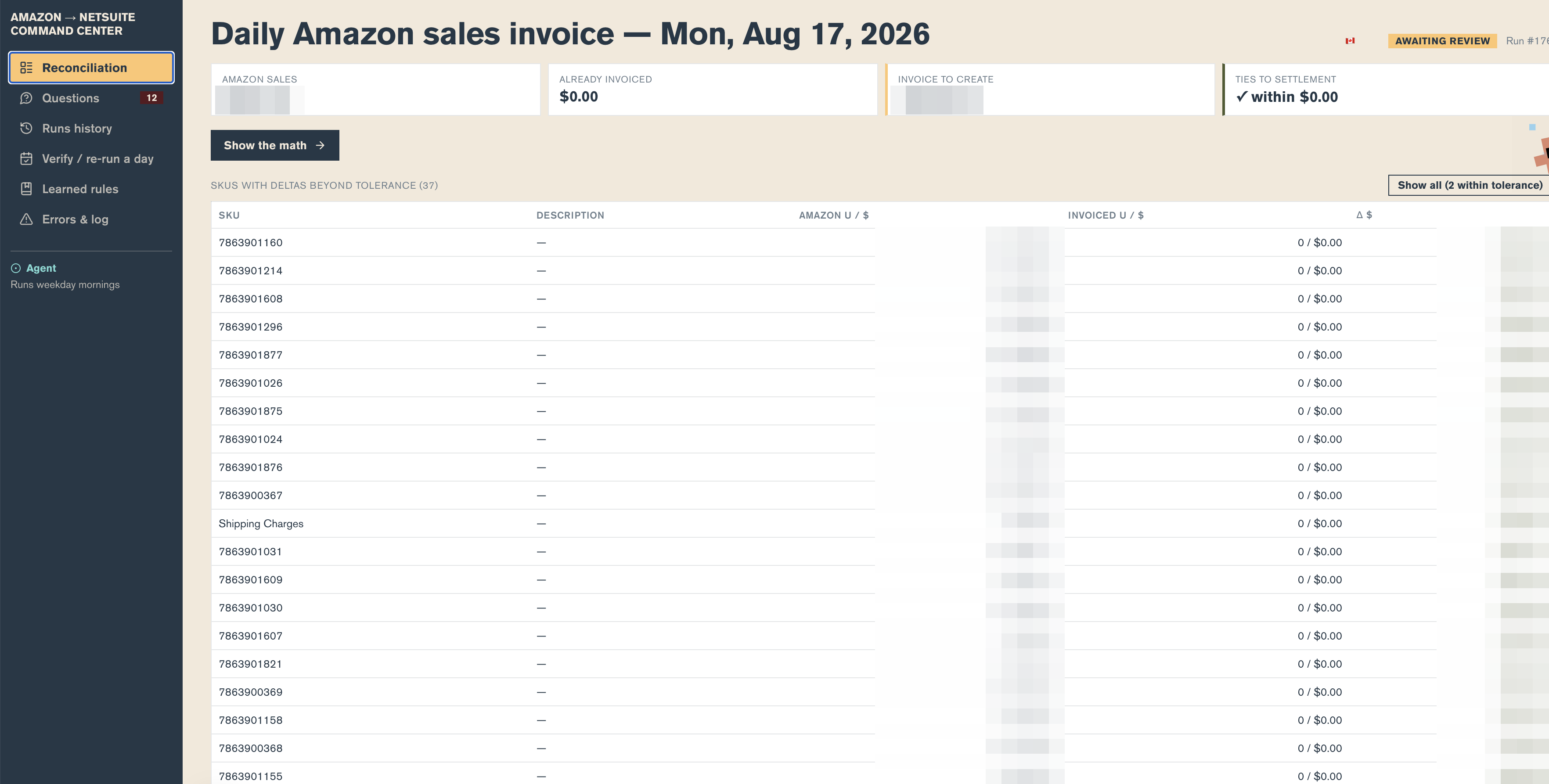
Drill into a run and you get the reconciliation: what Amazon says the day sold, what’s already invoiced, what the draft invoice will create, and — the line I care about — whether it ties to the settlement. SKU-level deltas beyond tolerance are listed right there, with a “Show the math” button for the skeptical.
The guardrail is the feature
The agent drafts; it never posts. Every invoice sits in awaiting review until a human on the A/R team approves it, and only then does it become a real NetSuite invoice. There’s a questions queue for anything the agent isn’t sure about, a learned-rules page so corrections stick instead of being re-litigated every morning, and a verify/re-run view for auditing any single day after the fact.
That’s the pattern I keep landing on with AI against an ERP: let the model do the math, the filtering, and the tedium at 6 a.m., and let a human spend thirty seconds deciding whether to press the button. The A/R team stopped keying invoices. The invoices tie to settlement to the penny. And when Amazon rewrites history, the true-up is already drafted before anyone noticed the drift.